Showing posts with label fairy tale study. Show all posts

Friday, November 29, 2019

Give A Truly Folkloric Gift This Season: A *New* Winter Folklore Mini-Course Or A Self-Guided Long Course In Fairy Tale Classics! (Psst! BlackFriday Deal Alert!)

The award-winning Carterhaugh School of Folklore and the Fantastic have TWO new courses enrolling, a winter folklore mini-course and a self-guided master course on fairy tales... AND they're both 15% off right now with code WINTERMAGIC! (Sale through Monday 12/2/19.)

Here are some more details to entice to you join - or gift! - the growing community of folks avidly learning about folklore and fairy tales under the guidance of folklorists Professor Brittany Warman and Professor Sara Cleto. We got the chance of a fly-by catch-up with our fairy tale professors to ask them a couple of fun questions for you about the courses as well... (see the text in blue below each of the course descriptions):

The first course is perfect for the Winter Season and has been created by popular demand after the rousing success and high attendance in Carterhaugh's Halloween mini-course. The new interactive Winter course begins on January 8, 2020:

Enrollment is OPEN for our new mini-course “Kindling a Light in the Darkness: Winter Folklore and Fairy Tales”!
Let’s face it: the long dark of January and February is BLEAK. Once the December lights come down, the turkey (or, if you’re like us, Tofurkey and every last potato in town) has been gobbled up, and the fizzy champagne countdown to New Years is over, facing the cold winter months can feel seriously depressing, And so, we want you to join us in kindling a light and sharing a story or two when the year seems darkest.
By popular demand, we’ve conjured up another interactive Carterhaugh mini-course for you, poised right in the coldest and loneliest time of year. We invite you to take shelter from the wind and snow, pull up a chair by our fire, and gather round for stories, fellowship, and rituals to warm you down to your toes. Through a combination of video lectures, written tales, extra resources, and group discussion, we will lead you through some of our favorite winter folklore and fairy tales!
For more info and to enroll, visit HERE.

Speaking of favorite Winter folklore, we couldn't resist a pop-quiz question on the topic for the Carterhaugh School Fairy Tale Professors:

OUAB: You are having a decadent Winter Feast and need to invite: one folkloric character, one fairy tale person, one ghost and one animal. (Don't worry. They have promised to keep their hooves/paws/trotters off the table). Whom would you invite to your festive evening?

SaraPersephone (because, between bouncing back and forth between the underworld and the surface, she's learned to be a good conversationalist with all kinds of different people), Lady Mary from the fairy tale "Mr. Fox" (because she's one of my fairy-tale heroes - girl is FIERCE), the Ghost of Christmas Present (because he'd be so happy to be there), and Tatterhood's goat (because she is a fine and noble steed)!

BrittanyThe White Cat (who yes, is from a fairy tale too, but fairy tales are folklore, sooooo 😝!), the 13th fairy from “Sleeping Beauty” (because one simply does not NOT invite her, as we all know!), the Ghost of Christmas Past (bc I’d love to have a peek back in time of a Christmas with some of those I’ve lost over the years), and one of Santa’s magical reindeer (probably Vixen, I always loved her name!)

BONUS FOR EAST COAST FOLKS: For those interested in the darker side of Christmas, Yule and Winter holiday traditions and tales, on December 17th, 2019 there is a LIVE Profs and Pints talk in Washington DC – “You Better Watch Out: A Look at Terrifying Holiday Folklore Around the World” – A little note: these live sessions have been SELLING OUT so if you're genuinely interested in going, grab your tickets ASAP HERE. Here's a taste:
Today, the December holidays are all about joyous magic, warm evenings curled by the fire, and celebrations of the good in the world. Traditionally, however, the winter season also ushers in the terrors of the dark and the cold, teaching us to bar doors, whisper warnings, and, above all, to be good for goodness sake. 
While many are now familiar with the holiday terror of the Krampus, this talk will explore a few less familiar, but no less frightening, folkloric characters of the season. 
You'll hear tales of the Icelandic Jólakötturinn, a gigantic cat that devours naughty children, and learn how to best the Welsh Mari Lwyd, a skeletal horse with a taste for song and poetry. You'll get to know the Eastern European Christmas witch Frau Perchta and trace the history of the sometimes mischievous, sometimes terrifying Yule Lads and their monstrous mother, Grýla.
The second offering is an in-depth master course in the classic fairy tales, consisting of ten comprehensive lessons:

Introduction to Fairy Tales
A self-guided course through classic tales and traditional folklore

Once upon a time...
A girl in red walked into the woods with a basket for her grandmother. There, she wandered from the path, talked to a strange wolf, was eaten, was saved.

Or, once upon a time…
The girl, who did not wear red, went into the woods. She met a werewolf, chose the Road of Needles instead of the Road of Pins. She performed a striptease for the wolf, tricked him, and ran back home, and slammed the door behind her.

Or, once upon a time…
A girl, once more in red, walked into the woods. She wandered, talked, was eaten. She was not saved, and she remained in the wolf’s belly.

A teeny preview of one of the beautiful
'grimoire' pages created for participants
to download & collect into their
own personal study volume.
To read the info-goodies you will have
to join..


In this self-guided online course, “Introduction to Fairy Tales,” we welcome you across the threshold of Carterhaugh to explore a collection of wonder tales from around the world- stories you may know, stories you may think you know, stories that are strange and unfamiliar. Through a combination of video lectures, supplemental readings, and extra resources, we will introduce you to the wide world of fairy-tale scholarship and provide the history, context, and tools to begin analyzing these stories and applying them to your own life.

For more info and to enroll, visit HERE.

Applying fairy tales to one's own life felt like it deserved a pop-quiz question too. Sara & Brittany very kindly humored us with wonderfully reflective answers...

OUAB: As you explain in this course, fairy tales are classified by their "tale-type" or "the things that happen in the fairy tale" and can sometimes reflect people's lives. While therapists can use this as a tool of exploration, just for fun, what would you each say is a "tale type" you feel reflects an aspect of your lives? (To make it harder we're nixing the reply of regularly losing shoes like Cinderella...)

BrittanyI’m going to have to go with “Sleeping Beauty” for this question. Most people know it’s my favorite fairy tale, but I also feel a deep connection to the story. All my life I’ve been shy, quiet, and typically not too willing to stick up for myself... sleeping, in some sense. But the older and more confident I get, the more I feel I am “awakening” from that, awakening to the person I’m truly meant to be. And that, to me, is kind of what “Sleeping Beauty” is all about.

SaraThe answer I give to this question will change depending on the day, but today, it's "Snow White." "Snow White" was my least favorite fairy tale growing up, because I thought Snow White was really weak and passive - and I wanted so badly to be strong and confident. As I've grown older (and given this fairy tale a lot more thought), I've realized that "Snow White" is a story about survival and success, despite incredible odds. I've grown much more compassionate towards Snow White herself (who is only seven years old in the Grimm version!) and more compassionate to myself, especially when I think about my own challenges through the lens of this particular fairy tale. 

Thanks Sara & Brittany! We love the humor, delight and insight you bring to every conversation - even pop-quizzes!

We at Once Upon A Blog have participated in a few Carterhaugh courses and highly recommend them both to people new to fairy tale studies, as well as those looking for something a little more in-depth. Both Sara and Brittany are wonderfully enthusiastic while being well-researched and clear in their unique tag-team style teaching. There's nothing quite like it anywhere else, and best of all, being based in an online format, their courses are available for ANY enthusiast, no matter their background, level of education, or location (yes - there are students joining from all over the world!) and they are committed to making this learning opportunity available at an affordable price. They are forever expanding their courses and the ways in which they are teaching and we feel lucky to have seen the formation of this wonderful school that was recently awarded the Dorothy Howard Prize, as recognition of
excellence, relevance, and innovation in folklore education, by The American Folklore Society. (In case it's not clear - this school is considered excellent by all those professional folklorists you respect!)

We hope to see some of you in the courses to come!

Friday, October 18, 2019

Maleficent As A Modern Day Mélusine

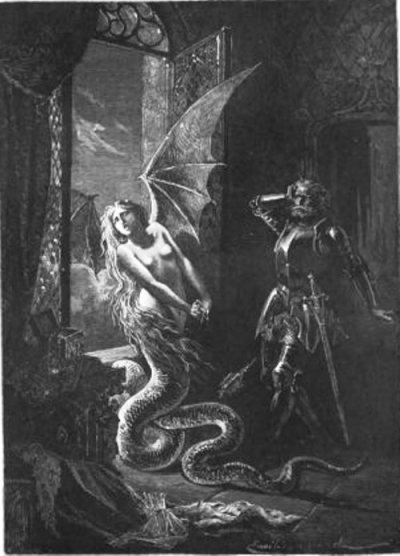
Image
[Art: ‘Melusine’, from “Les grandes Sataniques de l'histoire de la Légende” by Roland Brévannes, Select Bibliothèque, 1907]
Maleficent (Disney 2014)
Note: This theory/exploration was put together for #MythologyMonday back in August on Twitter*, by our Editor Gypsy Thorton, using the character limited format. We have expanded and reworded some of her tweets for easier reading (starting below our intro and the dragon flanked with stars).

This is a set of linked tweets (known as a 'thread') exploring the possibility of Maleficent (being a dragon-shape-shifter) as a modern variant of Melusine. (When Gypsy contributes fresh content, she will inevitably find a way to reference fairy tales, no matter what the theme is.) We, too, believe there is a fairy tale link to every topic and situation under the sun...

With Maleficent: Mistress of Evil opening in theaters today, we thought it might be fun to expand the thread for a blog post, even though it has no real bearing on the Disney's live-action Maleficent movies... or does it?
Melusine and Raymon by Troy Howell
Who was Melusine? (A Quick Refresher)
(Description via Storytelling Toronto):
Melusine is both a mythic and historical character in French legend. She is best known for her secret: that every Saturday, she had to disappear into the bath, where the lower part of her body took on the form of a serpent. 
Melusine was a great queen and benefactress. Her mother was a “maiden of the wells,” a fairy from the “Lost Isles” of Avalon. Her father was a mortal king, the king of Albany, now Scotland. Melusine became entangled in mortal life, married, and had ten sons who were powerfully gifted and cursed. She was said to have built many cities and abbeys, some of which still exist in France. This mythic queen left her imprint on the physical landscape of France and Scotland, and her baffling story draws us back to early Christianity and the demonization of the enchantress.^
Melusine escaping: Cover of
'The Legend of Melusine' (French)
by
Michèle Perret (artist unknown)
As she was finishing her story-thread on Twitter, Gypsy found a recently-published scholarly compilation for which one of the contributors apparently had similar thoughts, including a discussion of the link in their paper. She included mention of the book at the end of her tweets (see end of the post for the title plus a description and relevant excerpts we were able to hunt down) but we had hoped to obtain a copy to read before sharing it all here. Unfortunately, this is one of those uber-expensive volumes (upwards of $100!) so, apart from some interesting sneak-peeks via previews (which we will also share excerpts of below) we're just going to have to keep it on a watchlist.

In the meantime, we remain thrilled that some medieval literature and legend experts had also found a connection to Maleficent, taken their scholarly skills, time and effort to do comprehensive research, then published an exploration of the concept as part of their work. Their discussion of Maleficent's story having included some of the Melusine narrative in a modern form, though, is only a portion of one of the included papers in the book. From the excerpts we've been able to glimpse in previews, all other aspects are just as interesting. We are looking forward to the time we can read it in full. (Details and links at the end of post.)
Enjoy!

* * * Dragon on LG G5 * * *
Today's theme for #MythologyMonday (August 29, 2019) is #MythologicalCreatures, so let's talk shapeshifting dragons, female ones; especially one in particular: Maleficent, but not as she's usually considered.

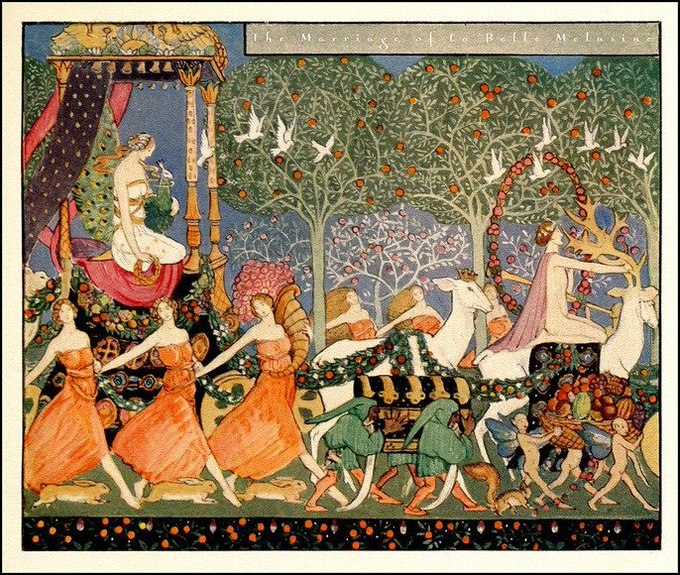
Imagine Maleficent as a 'modern' day Melusine, as some versions of the legend say Melusine was. (Not a mermaid, or typical fairy, but perhaps a type of fairy-wyvern hybrid, which fits with the text).
Image
[Art: The Marriage of Le Belle Melusine, Jessie Bayes, 1914]
Now imagine Melusine/Maleficent as a younger, more innocent creature. One day, when she was happily wandering in the woods, she met -some versions say rescued- a young French lord, Raymond of Poitou, and they fell in love.

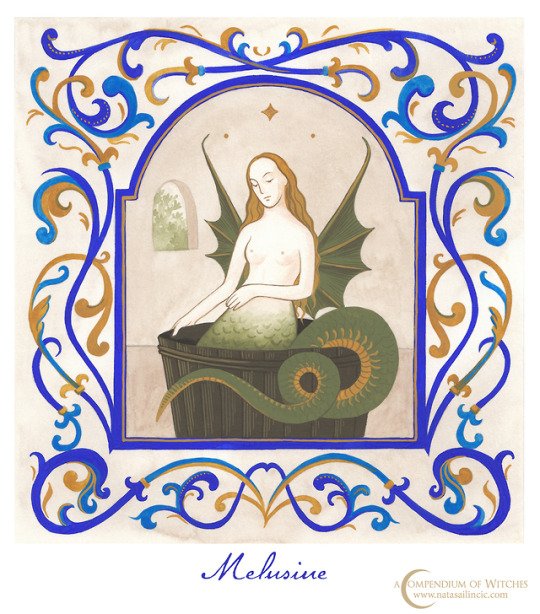
Before long they were to be married. He didn't know she was Other and, in love, promised to give her the privacy of a private bath on Saturdays - with no peeking - ever!
Image
[Art: Nataša Ilincic]
Melusine was a prize for the Nobleman; not only was she beautiful, she made him 'lucky'. In reality, she used her dragon-hoarding abilities to attract wealth & built castles for him. She was very fertile, giving him ten children, with not a single hybrid among them to give her away, though they did have unusually large teeth and brilliant eyes...**
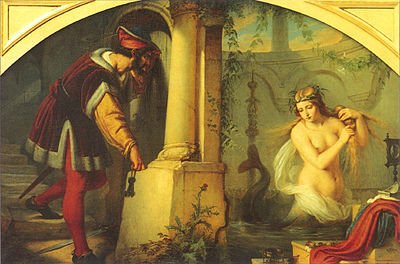
Image
[Art: Julius Hübner 'Die schöne Melusine' 1844]
But Melusine's husband (Raymond) had a jealous brother who 'bedeviled' Ray with doubts about Melusine's faithfulness. Eventually (after at least ten children had been born) Ray gave in to his brother's decade-plus of mind-poisoning, and he finally broke his promise to Melusine, spying on her. He discovered her in her marble bath in partial-dragon form and, his mind already set against her, recoiled in horror.
Melusine / Illumination, Flemish, c. 1410–1420, attributed to Guillebert de Mets.
“Melusine s’enfuit transformée en vouivre” (Melusine flees disguised as a dragon).
Betrayed and heartbroken, Melusine spread her dragon wings as she backed away to the nearest window then, with a cry, fled the castle forever.
Image
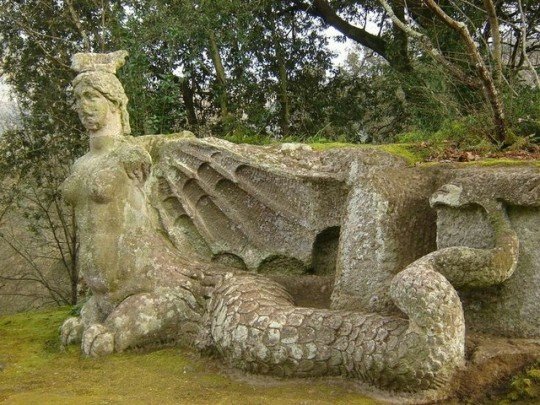
[Art: The figure of Melusine, at the 16th century sculpture garden of Bomarzo, Italy.]
Though poor Melusine had fled for her life, she was heartbroken and missed her family. It was said she could sometimes be spotted, high above the castle, weeping. (Legend says you can still see her on moonless nights.)

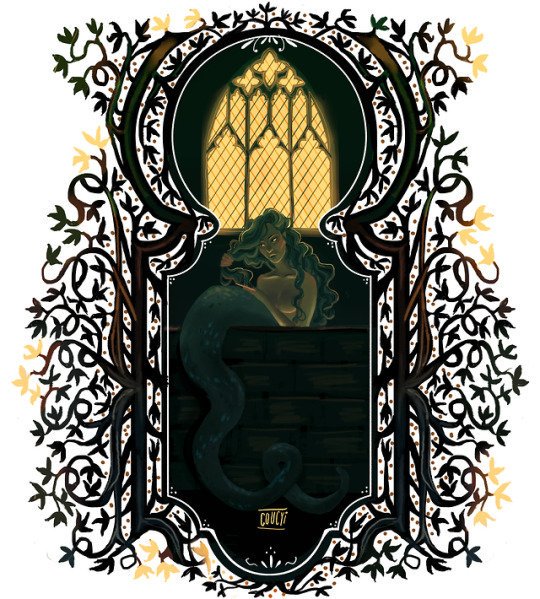
Some say Melusine was a fairy, or mermaid or a serpent but don't believe it - she was a dragoness.
Image
[Art: by coucyi on Tumblr]
Did Melusine end up taking residence in a castle that crumbled to ruin over time and failing fortunes?

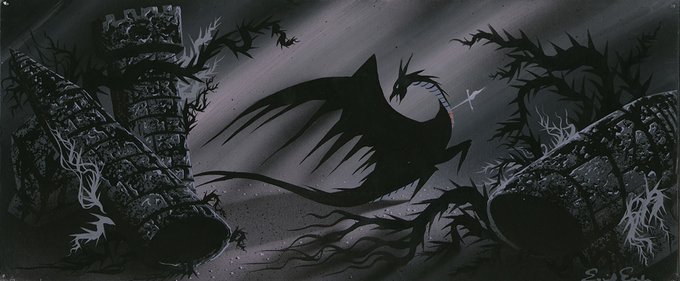
Did she become bitter and cynical about true love, vowing to thwart foolish young noble women, cursing them to sleep before they could have their freedom -and their love- betrayed?
Image
[Art: Eyvind Earle concept painting of "Maleficent" as the Dragon from Sleeping Beauty. (Walt Disney, 1959) ]
And did she finally give in completely to her true draconic nature when a young princess, hailed the Dawn of the New Age+, was about to make the same mistake she once had in the woods, only to tragically become a trophy once again, only this time on a Prince's wall?

We'll never truly know. All we can say in certainty is that loving a dragoness is not for the faint of heart.
#MythologyMonday #Maleficent

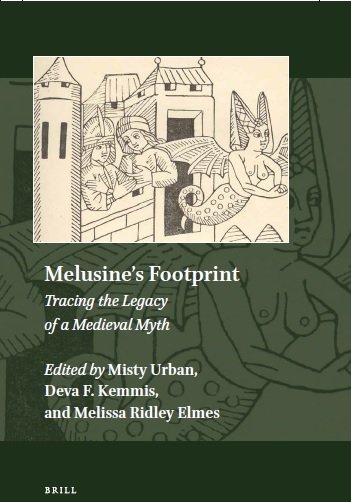
[To trace more scholarly musings on Melusine, this book may be of interest: "Melusine’s Footprint: Tracing the Legacy of a Medieval Myth"]
Image
Description:
Melusine's Footprint: Tracing the Legacy of a Medieval Myth
Editors: Misty Urban, Deva Kemmis, and Melissa Ridley Elmes
In Melusine’s Footprint: Tracing the Legacy of a Medieval Myth, editors Misty Urban, Deva Kemmis, and Melissa Ridley Elmes offer an invigorating international and interdisciplinary examination of the legendary fairy Melusine. Along with fresh insights into the popular French and German traditions, these essays investigate Melusine’s English, Dutch, Spanish, and Chinese counterparts and explore her roots in philosophy, folklore, and classical myth. 
Combining approaches from art history, history, alchemy, literature, cultural studies, and medievalism, applying rigorous critical lenses ranging from feminism and comparative literature to film and monster theory, this volume brings Melusine scholarship into the twenty-first century with twenty lively and evocative essays that reassess this powerful figure’s multiple meanings and illuminate her dynamic resonances across cultures and time. 
Contributors are Anna Casas Aguilar, Jennifer Alberghini, Frederika Bain, Anna-Lisa Baumeister, Albrecht Classen, Chera A. Cole, Tania M. Colwell, Zoë Enstone, Stacey L. Hahn, Deva F. Kemmis, Ana Pairet, Pit Péporté, Simone Peger, Caroline Prud’Homme, Melissa Ridley Elmes, Renata Schellenberg, Misty Urban, Angela Jane Weisl, Lydia Zeldenrust, and Zifeng Zhao.
* * * Dragon on LG G5 * * *
Almost a month after Gypsy's story thread, one of the editors, Dr. Melissa Ridley Elmes, added this tweet for the #FolkloreThursday theme of the week: Mythological Creatures
Since first finding Melusine's Footprint, we have tracked down some previews and excerpts that include discussion of Maleficent. Here's a small taste:

[From Misty Urban's paper: How the Dragon Ate the Woman: The Fate of Melusine in English:]
... in what might so far be the closest reunion of the dragon and the woman on the screen of a blockbuster film: Disney's 2014 live-action Maleficent, which re-envisions the supernatural fairy enchantress of the Sleeping Beauty legend into a figure much like Melusine. With horns on her head highly reminiscent of the headdress Melusine wears in late medieval and early modern woodcuts, the fairy Maleficent otherwise appears human in form save for a pair of wings, of which she is deprived in the course of the movie by a false lover. The Maleficent of this film harbors strongly protective maternal instincts and is a powerful enchantress with unlimited resources who can physically transform her kingdom at will and who is its recognized ruler. While male betrayal is a prevalent motif, the emotional charge of the narrative rests on the way that the two central female characters lift the curse on each other: Maleficent herself breaks the curse of the death-like sleep she laid on Aurora, and an awakened Aurora consequently restores her wings to Maleficent, who, in a film moment highly evocative of Melusine's final exit transforms into  winged creature, exits the castle that entraps her by shattering a stained-glass window, and then flies about the parapets, screaming, as she sends the malicious King Stefan to his death. [Urban pp. 386]
Melusine - Illumination, French, 15th century.
"Melusine escapes Raymond in Dragon form / Melusine appears to breastfeed her sons". Illustration to the "Roman de Melusine" of the troubadour Couldrette (1401). Ms français 383, fol. 30, Paris, Bibliothèque Nationale.
And, an excerpt from the final paper, commenting on what this anthology volume adds to the already extensive scholarship published on Melusine:
Urban's contribution reveals that the decades following second wave feminism have witnessed the return of a polymorphic Melusine in innovative new interpretations. Constrating with premodern tendencies to soften Melusine's hybridity, young adult fiction has endowed the fully serpentine character with an apotropaic role, while the metamorphic, aerial Maleficent, who sits at the heart of a Hollywood fantasy film exploring women's protective and destructive qualities, strikingly revels in her alterity. [Colwell, pp. 398]
You can purchase the book HERE at the publisher's website. This includes a list of the papers included. Each 'locked link' still gives you a limited preview (after clicking on the chapter title), and is great food for thought, even just having a glimpse. Alternately you can find a copy (often cheaper) HERE on Amazon.

And if you go see Melusine, er Maleficent: Mistress of Evil in theaters this weekend, drop us a line, a comment or tag @inkgypsy on Twitter, and let us know your impressions.
^ You can read a more detailed story-like summary of Melusine, including why she had to bathe every Saturday in semi-dragon form, HERE. (Note: the website is in French - Google translate gives you the gist but knowing some French helps!) Otherwise, Wikipedia's Melusine entry has a lot to offer and link you to, if you want to begin a "deep dive".

‘Melusine’, from “Les grandes Sataniques
de l'histoire de la Légende” by Roland Brévannes,
In case you are interested in joining in on social media and saying 'hi', Gypsy does her best to visit three different Twitter weekly events (even if only briefly, or toward the end of the time frame). They are:
#MythologyMonday
#FairyTaleTuesday
#FolkloreThursday
Just put the hashtag in the search box to find all the tweets. Everyone is welcome to observe, tweet and contribute and each week usually has a theme, though off-topic mythology, folklore or fairy tale information, art, and questions are OK too. You can just search the hashtag and read without posting, or reply and have a discussion, or add a new tweet to the content - whatever you'd like. Just be sure to add that day's hashtag so people can see your comments. Each group has a lot of overlap and all of them are very friendly folks.

** Wondering what happened to those large-toothed, brilliant-eyed children?  Here you go (via Castles, Celtics & Chimeras):
The Ten Children of MélusineMélusine gave Raymond ten sons. But the count, though very proud of having so many children, was not always very comfortable looking at them.
1st: Urian - who became king of Cyprus - was "in every way well-formed, except that he had a short and full face, a red eye and the other person [blue and green], and the largest ears that have never been seen to a child;
2nd: Eudes , had an unquestionably larger ear than the other ";
3rd: Guion , had "one eye higher than the other";
4th: Antoine, handsome and well made like his brothers, except that he wore "a lion's paw on the cheek, and before he was eight, he became hairy, with sharp claws"
5th: Renaud , had only one eye, but remarkably piercing;
6th: Geoffroy , had a 3 cm canine that came out of his mouth;
7th: Fromont , who became a monk at Maillezais, had a hairy spot on his nose;
8th: Horrible , incredibly tall, had three eyes, and he was so ferocious that before 4 years old he had killed 2 of his nannies ".
9th: Thierry , was normal;
10th: Raymonnet , was normal too.
+ Aurora (Disney's chosen "princess name" for Sleeping Beauty, who, in the animated classic, which Maleficent references, grows up being called 'Briar Rose', or just 'Rose' by the three fairies, Fauna, Flora and Merryweather.)

Saturday, November 11, 2017

Cinderella: Stop Blaming the Victim - A Timely Interpretation of Disney's 1950's 'Cinderella'

A thought-provoking video was posted this morning on YouTube and we felt it so important, we decided to do a full post, rather than just retweeting. (Video is embedded below.)

This interesting  - and wonderful - analysis of the iconic 1950's Cinderella, couldn't have come at a more opportune time. And it might just make you pull out the movie for a re-run too, because, yes, it's that empowering.

By the way - important to note here, is that it mentions that even the Disney Company itself, now considers the Cinderella animated movie as passive, and not the best role-model for girls, with the title character relying on others to be rescued.
   
Yet, from the video:
But the criticisms (of the film) usually focus on our culture's shared interpretation of Cinderella, not what the character actually says and does in the film.
And yes, ironically, that conversation has been largely influenced by Disney's own marketing!
Critics of the movie probably feel they're espousing girl power by attacking the damaging idea that a happy ending equals a handsome prince. But counterintuitively, the tendency to dismiss Cinderella might actually be a little sexist. 
Perhaps there was more thought - possibly even respect - put into the movie than anyone has realized. From this video analysis, it would suggest so, or at least that the fairy tale source variants it drew on had enough substance there to subliminally affect - for the better - how Cinderella was portrayed (credit was given to Perrault as the source, but other variants were looked at during research in early stages of development as well).
      
KenAnderson - development for Disney's Cinderella (1950)

For the 'timely' context - and why this conversation is important to have right now - (since this post will quickly go to the archive and found later, when the world is, hopefully, different), we are in the midst of a deluge of accusations against many figures in positions of power, citing sexual misconduct, abuse and rape. These allegations are being made by people in the wake of the Weinstein accusations, who have finally felt able to come forward and be heard (though for many this is not the first time they are telling their stories). 

As the backlash continues, with people scoffing at the stories, even sometimes attacking those abused, we feel it's important to keep explaining, that reporting abuse, standing up to abuse, is very, very difficult. It's not overstating it to say "silence has equaled survival" for many, many people, on many levels, including physical safety. No one owes anyone their stories - or the details, or names. #metoo It is the first time, the pervasiveness of this abuse is clear and the victims are not being dismissed. So many are coming forward now, precisely because there is safety in numbers, but never underestimate just how hard that is to do. It changes everything and affects not only the individuals but their families too.

Fairy tales are full of women who have been abused and people are drawn to different tales, not only because they sometimes see themselves in those characters, but also because they find hope in those stories too. The recent Disney/Branagh live-action action Cinderella, though not perfect, took care to more clearly show feminine strength at work in an abusive situation, making people take a second look at the Cinderella fairy tale, as well as the classic animated film it was based on, and garnering an appreciation for it that has been largely lacking for the past few generations.

This awesome video analysis that highlights the strength of that 1950's Cinderella, is wonderful to watch - clear, beautiful and explaining the points with clips. It's a little longer than your usual internet clips, at 13-ish minutes, but highly recommended (you won't be bored).
There are two specific sections for which we have taken the time to transcribe the narrative so that the observations/ interpretation won't be lost, should the video link ever not work.

The first excerpt, analysing the Fairy Godmother appearing, is new to us with regard to the Disney Cinderella movies (both of them), though in some of the Cinderella variants from around the world, this manifestation of the Fairy Godmother as Cinderella's 'wish', that is, a maternal figure of help and guidance, is more clear. Although we don't believe this was the intent of the filmmakers to show this (based on our longtime research, though, to be clear, we are not experts on the making of this film) it makes a wonderful sense and feels like one of those wonderful subconscious ideas that were included. Perrault, who was the writer to first include the fairy godmother, does not appear to have added the magical figure for this intention, but we are rather tickled that, using this interpretation, Disney's version is the one that links this idea back to many other versions of Cinderella.
We also love that this is another example of amplifying the potential of things - that transformation (of things and people) is possible because of what already existed.
Cinderella's inner strength and tireless imagination manifest physically as the Fairy Godmother. It's when she believes she's hit rock bottom that her Fairy Godmother materializes, and the reprise of "A Dream Is A Wish Your Heart Makes" tells us that she is the embodiment of Cinderella's dreaming or her heart's wish. When she needs it most, Cinderella has willed a loving maternal figure into existence. Since she has no real family, the fairy represents her determination to mother herself. 
The Fairy Godmother's magic work through imagination, creativity, and resourcefulness -- all qualities that Cinderella relies on for her survival, as that represent her true powers. Each magical transformation finds hidden potential in what Cinderella already has. A pumpkin becomes the carriage, the mice become horses, and Cinderella's horse, who assumes he'll pull the carriage, becomes the coachman. 
Gus's transformation especially symbolizes how imagination can help us overcome our oppressors. When he's transformed into a horse, he's finally able to escape Lucifer's clutches.

This second transcription, looking at Bruno, the dog, being paralleled with Cinderella isn't a new thought, so much as it possibly the most succinct example we've ever heard of a victim juggling the ever-present issues of needing to sometimes to be passive for the purpose of survival, versus taking action.
Cinderella demonstrates that real kindness is active, not passive. Rescuing her friends in this oppressive household is brave and heroic... When Gus gets stuck in a mousetrap, we see that Cinderella is quick to help those who can't help themselves. And she's spirited -- she doesn't hesitate to tease her friends -- or stand up for herself in her interactions with Lucifer. These interactions are important to show us that Cinderella's not a pushover. She knows when she's being treated unfairly, and, when she can object, she does. But there's a distinction between this and someone who represents a truly grave threat to her safety. When Cinderella tells Bruno to stop dreaming of chasing Lucifer, it's because disobeying Lady Tremaine's orders could result in losing his home. She knows that Bruno's situation could become parallel to her own, and she's been forced to value practicality over justice in order to survive. Near the end we see a return to this parallel between Cinderella and Bruno. At this critical moment, Cinderella decides that Bruno should disobey orders, despite the dangers, because they have a real opportunity to escape.
To be able to recognize that moment, and then act, is strong indeed.
Artist unknown - created for Disney's Cinderella (1950)

Note: (Emphasis in bold on transcripts added by us.)

Wednesday, November 8, 2017

Closing In On 10 Years of 'Once Upon A Blog: Fairy Tale News' & Looking To The Future


Would you believe we're closing on TEN years of Once Upon A Blog reporting fairy tale news? (Spring 2018 will be the double digit anniversary!)

As Creator and Editor of this now-gigantic, ongoing project, I feel it's about time to reassess what it is I'm doing with the blog, and how, which is what the last couple of months of quiet have been all about - making a fresh plan.

Don't worry: I'm not about to abandon my lifelong obsession love of fairy tales!
Since social media has come to dominate the scene in the past decade, however, most people are getting their news through Twitter, Facebook etc and it's pretty much impossible for a single blog to compete with that. I have also finally acknowledged that the job I created Once Upon A Blog for - to keep track of fairy tale use, news and events in our modern world - isn't needed quite so much anymore.

With so many awesome resources all over social media (and the rest of the internet) for fairy tale folk, I need to acknowledge - and be thankful - that so many others are alerting us all to what's happening. So it's time to focus the blog more on the fairy tale news, issues, books and events that truly grab my interest, instead of trying to (primarily) report news I feel the fairy tale community should know. For day to day fairy tale news and events I will focus on using social media, amping my use of Twitter (which has been fairy tale focused even longer than I've been blogging here).
(And yes, I will still be happy to promote/review books and events, both on Twitter and here in long form, as I can manage.)

I also recommend other regular stops so you can get your daily fairy tale fill. [In no particular order.]

Linking you to fairy tale goodness daily:

  • Fairy Tale News (InkGypsy) on Twitter - so it's in the linky-list, yes, that's the OUABlog Twitter. I've been on Twitter a long time and my account is largely fairy tale focused, though you will see folklore, storytelling, D&D and the occasional personal post on there too. I tweet and retweet fairy tale links I want to highlight almost every day, along with folklore things and mythic and/or beautiful art
  • Timeless Tales Magazine's Facebook - our ongoing partner, Tahlia Merrill and her social media wrangler, Carina Bisset, have been linking folks to fairy tale, folklore and mythic news, links and art multiple times a day (they are on Twitter too but FB is their focus), balancing articles with lovely art
  • Maria Tatar's Twitter - one of the most social-media-accessible fairy tale professors around is often one of the first to link to breaking fairy tale news
  • #FolkloreThursday - the hashtag on Twitter is more active than ever and growing in users all the time. While not strictly fairy tales, there's a lot of overlap and it's great for research, writing, inspiration or just bringing a bit of magic to your day. From, facts and article linking to questions and answers, it's so big that there are new #FolkloreThursday posts most days, though Thursday's use of the hashtag (wonderfully) fills pages
  • Dr. Grimm on Twitter - fairy tale tweets and retweets
  • Fairy Tale Papers on Twitter - university related fairy tale links and tweets - your FT study starting point on Twitter!
  • Sussex Centre for Folklore, Fairy Tale & Fantasy - daily fairy tale and folklore tweets, retweets & news - a wonderfully accessible academic social media source as well

Daily folklore & mythic news, conferences, updates and inspiration, with fairy tales included:


Note: there are MANY other accounts worth following that tweet fairy tale, folklore, myth and all forms fo inspiration. These are just the most regular of the top folks.


There are many awesome sites publishing all the time and between them all, there's almost always something new to read every day. You can check the sidebar linked list to find them! 


Regular new fairy tale short stories (multiple times a year):

  • Enchanted Conversation: A Fairy Tale Magazine - Kate Wolford remains the best regular advocate and publisher for fairy tale writers on the internet. Her new assistant Amanda Bergloff is helping her do this better than ever.
  • Timeless Tales Magazine - Tahlia publishes new fairy tales and retellings, carefully selected, every second issue (with myths being the focus in between).

I'm still active on Pinterest and the Enchanted Gallery on Tumblr gets some attention every so often as well, so there's still plenty of fairy tale goodness coming at you from this corner of the web! Looking forward to connecting with even more fairy tale friends and seeing us all take our tales into the future together.

Note: All the lovely art is by Sara Kipin. The header and footer are from her tarot series and the images in the center are from the book The Language of Thorns: Midnight Tales and Dangerous Magic by Leigh Bardugo - a gorgeous and very different collection of fairy tale and folklore-based tales. The book has readers smitten and the tales have captured imaginations. Definitely one to check out!

Saturday, July 8, 2017

Google Translate Sings 'Aesthetic & the Animals' (aka B&tB) aka the importance of good translation!

Ah Google Translate! Where would researchers and far flung friends and colleagues be without you? Performer Malinda Kathleen Reese gave us a glimpse of what non-English speaking folks, trying to translate tales and lyrics via Google Translate, might be 'hearing' instead...
This is a bit of (very well done) fun, of course, but it illustrates wonderfully why, when studying tales translated to English from other languages, you should be aware of the translator and how accurate they're considered to be, or (if you're lucky and have their notes) why they chose to use certain words and phrases instead of the more obvious ones... for instance the ones the Google Translate might suggest. ;)
             
One of the difficulties in translating to English is that it's a very imprecise language and definitions are constantly evolving, because social and popular meaning changes. And that's only half of the equation. The other is the original language and its quirks. If you've ever dabbled in languages with even minor translation endeavors, you quickly learned that there is rarely a 'correct' way to translate  - except that the guaranteed 'wrong way' is to try the word-for-word method - and that it's more of an art form than a science of substituting equal meanings.

You have to take into account:
  • the words and what they specifically mean (and their equivalent in the language you're translating too)
  • what the words also imply (the subtext of using that specific word instead of similar ones), which is influenced by...
  • the context at the time - and place - of writing
  • all of which usually has a 'tone' and style
(A very small selection of recommended books of translated tales with lots of great notes!)

And that doesn't include:
  • storytelling style - which is very important in translating tales
  • cultural expressions, idioms, similes and metaphors
  • those words that have no English equivalent
(And there are more factors too that a qualified folklorist or professional translator could discuss at length, but you get the idea.)

When you take these into account, even retelling old tales originally written in English can prove tricky..!

Speaking of untranslatable words, can you imagine a retelling of Rapunzel, in which these words - wonderfully illustrated  by Marija Tiurina - are used? (Click on the images to see full size.)

And what about this one for Riquet of the Tuft?

You can find a lovely bunch of many more 'untranslatable words', that have been wonderfully illustrated HERE.

It's a pretty fascinating subject and we're a little in awe of people who translate tales and other creative and social works (not to mention those who facilitate United Nations negotiations!). Be prepared for a fun ride down a rabbit hole if you decide to look into this subject further!

(Note: our suggestion, if you don't want a world of instant-overwhelm, would be to start with annotated tales, and tale collections in which the translators include their notes on the story origins, collection and translation process, sometimes summarized in a foreword on each of the stories. Be prepared to never read anything quite the same way again!)

And just because these are a lot of fun, here's Malinda's latest Google Translate Sings video with a compilation of Mary Poppins songs. Enjoy!
Want more? Malinda has a bunch of princess songs too, in which she sings the original and has a 'sing-off' with the google translate version. Funny stuff!